Sunday, May 8, 2011

'The organization of which you are an exploitee'

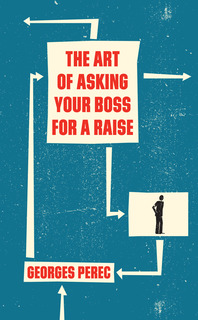
After reading a quite serious novel, which I will blog about soon but which was unsettling enough to first require some space, some head-clearing, I turned to and quickly devoured a wild little book of subversive mayhem: The Art of Asking Your Boss for a Raise by Georges Perec. Perec was a mid-20th-century French writer of experimental literature. I first heard of him a few years back when a new English edition of his book A Void was released. That one's an entire novel written without using the letter E. While something like that could easily be mere gimmickry, and while in my opinion there's nothing inherently interesting or meaningful politically about a project like that (unless there is of course, I mean unless the content takes on the class struggle in some way), still it piqued my interest and has been on my to-read list for a while. Because I do have a weakness for sly hilarity, and A Void sounds like that might be on offer.

Not having any academic or theoretical literary training, I know very little about experimental writing. I know it excites some folks, often younger folks who are fed up with conventional fiction, who seek work that breaks away from established standards and norms. I sympathize with that yearning. Yet I haven't read anything that convinces me that experimental fiction is by virtue of its formal departures revolutionary or contributes in any way to the revolutionary struggle. I have in fact read interesting counter-arguments, that such work is, thanks to its inaccessibility to most people, irrelevant at best and at worst just a less stodgy contribution to bourgeois culture. Myself, the few times I've dipped my toes in ex-lit waters, I found it arid or impenetrable or boring or irrelevant.
Not this time. I loved The Art of Asking Your Boss for a  Raise. I don't care at all about its genesis--experiments with computer programs, as outlined in the translator's introduction--in fact, I wish I hadn't read the introduction, for I'd never have imagined any remotely mechanistic origin for this witty gritty little spew of a book. No matter, for however the idea evolved the story's crazily revolving locutions could only have been cooked up in the labyrinth of Perec's evidently wonderfully skewed, demented mind. And it is a story. A story about an office worker trying to ask his boss for a raise. Told without sentence or paragraph breaks, without punctuation or capital letters. Without pause or breath. A breathless endless and endlessly futile quest as the worker in his heart of heart well knows, telling himself at one point
do not lose heart after all you make a decent living do you really need a raise if you cut out the unnecessaries heating clothing transport if you have lunch in the canteen every day and dine on boiled lettuce you should be able to make both ends meet in any case it's a well known fact that boiled lettuce sharpens the mind
Lots of commentary about work and big business sneaks into what at first glance might seem like an impossibly repetitive, minute, circular narrative about a guy going to his boss's office to ask for a raise, along with lots of comic detail about fish bones and bad eggs and measles and circumperambulation. So yes, there is social satire built in, yes the sum of this small gem is more than its kooky parts. And yes, I thoroughly enjoyed whizzing along on the ride. Fun! Everyone deserves some!

Friday, May 6, 2011

The ultra-reactionary chokehold

Playwright Tony Kushner has done some good work. His most famous plays, the Angels in America cycle, were some of the first mainstream drama to draw attention to how the AIDS crisis was devastating the gay community in this country. His musical Caroline, or Change, which I saw in 2004 during its all too brief Broadway run starring the soaring, searing Tonya Pinkins and the incandescent Anika Noni Rose, is an honest, tough-minded yet tender treatment of race, racism, and Black-Jewish relations in the 1960s South. Kushner is not a radical. He is thoroughly at home in the mainstream. Basically he is a left social democrat, a devotee of what he sees as the potential of bourgeois democracy while acknowledging its shortcomings, and also aware of other possibilities and even of the ubiquitousness of anti-communism in this country and how it has damaged and distorted culture. This brief take on his political sensibilities, based on having read a number of his pieces and interviews with him over the years, is offered to lead in to commenting on the current dust-up drawing much notice here in New York.

At its meeting this past Monday, the board of trustees of the City University of New York voted to cancel the honorary degree that John Jay College had planned to bestow on Tony Kushner at this month's graduation ceremony. The reason: the playwright is not sufficiently rabidly racistly violently Zionist.

He is a Zionist. A left-liberal Zionist, the sort who says "I love Israel" and expresses his "strong support for Israel's right to exist," but does oppose the occupation and criticize what he sees as its worst extremes in the treatment of the indigenous Palestinian population. Kushner has acknowledged at least some of the crimes committed during the creation of the state of Israel. Yet "the occupation" that he opposes is the post-1967 occupation of Gaza and the West Bank, not the larger occupation—that is, the theft of the entire land of Palestine, on which is imposed the Zionist state, a state that is by definition racist, exclusionist and illegitimate.

Never forget this: Tony Kushner, or I, or any U.S. Jew, can move to Israel at any time and get automatic citizenship. Simply because we're Jews (and, by the way, regardless of religious practice, smart move since most Jews are atheists). By contrast, no Palestinian-American—not a young person whose parent or grandparent was forced out of the family home, nor an elder who was herself/himself driven out of the house by the terrorist thugs whose murderous ethnic cleansing campaigns were crucial to the creation of a Jewish state—not a single Palestinian is permitted to return home to live. Think about that. I, someone with no tie whatsoever to "Israel," someone whose ancestry goes back to Eastern Europe for hundreds of years and to Spain for hundreds of years before that, could pack up and move there tomorrow. And be welcomed as an automatic citizen. But my Palestinian sister whose parents still keep the key to their stolen home in a precious box, who still yearn for home, who still grieve over their forcible expulsion from the land their people had lived on for untold generations—she is barred from returning. (Here I'll point again, for any who have not yet read it, to Susan Abulhawa's wonderful novel Mornings in Jenin, which conveys this reality in a gripping literary tour de force.)

So. Here's a famous playwright who despite all that proclaims his love for Israel. Who says he is "moved and excited by its culture, its meaning in Jewish history" (which is to my way of thinking a reprehensible sentiment since its meaning in Jewish history is a blot, a shame, a stain, a crime against humanity, a turning away from a tradition of righteous struggle and solidarity against oppression). Who does criticize some of its crimes, as indeed do many Israelis, but does not at all part ways with Zionism itself, or with a fundamental support for the Zionist state's right to exist. Who, furthermore, explicitly does not support the BDS—Boycott, Divestment, Sanctions—movement, an international effort to bring pressure on Israel to end the 1967 occupation even though that in itself is a moderate demand and the BDS tactic a time-honored one honed during the struggle against that earlier apartheid state, South Africa; but no, even so, Kushner opposes BDS. Here, in other words, is a friend to Israel. But in the landscape of U.S. culture, where the ultra-right has an ever tighter grip on consciousness and culture, even that is not good enough.

And so CUNY pulls his honor. And Kushner cries foul. In his letter to the board expressing his dismay at the action, he asserts his "strong statement of support for Israel's right to exist, and my ardent wish that it continue to do so." He decries the BDS movement, explaining: "I have never supported a boycott of the state of Israel. I don't believe it will accomplish anything positive in terms of resolving the crisis. I believe that the call for a boycott is predicated on an equation of this crisis with other situations, contemporary and historical, that is fundamentally false, the consequence of a failure of political understanding of a full and compassionate engagement with Jewish history and Jewish existence." You can read his whole letter here. I've included these several sentences, with which I could not disagree more—and the latter of which seems to me to smack shockingly of a Jewish exceptionalism that objectively aligns with the base racism of the Zionist ideology rather than conveying any meaningful point about the history of European persecution of the Jews to which he's obviously referring and to which Zionism was and remains a backward, reactionary response; his view, apparently, is that apartheid in Israel cannot be compared to apartheid in South Africa because those imposing apartheid in Israel had terrible things happen to their grandparents in Europe—I include his own words expressing his unfortunate views to show how far from anti-Israel Kushner is. As he indeed took pains to show. Which underscores how extreme is the chokehold of reaction in every realm of this culture.

Now Facebook groups spring up. PEN, that bastion of anti-communist bourgeois liberalism, enters the fray. No one asks why reactionary investment bankers and bosses sit in control over CUNY, the college of New York's working class funded by the workers' taxes; why the majority of the board is white when most students are people of color; why tuition is no longer free and is in fact about to go up drastically again, making college an unreachable dream for more young workers.

CUNY should belong to the people of New York City. Militant students are right now organizing to take it back, fighting alongside staff and teachers against the vicious funding cuts and layoffs dictated by the banks. This will be a long, hard struggle, but it can be won. When it is, when CUNY is in the hands of the working class, I'll love to see who that new improved CUNY chooses to receive its honorary degrees.

Friday, April 29, 2011

Morals, Marx & May Day

As often seems to happen after I read a good book, I've had an unsettled period, a couple weeks of neither-here-nor-thereness reading-wise. I've pulled out of it and am now engrossed in a fine novel. First, however, I spent the better part of a week trying to get through a book—and I did try! I violated my own rule about how many pages to give a book before giving up on it, gave it well over 100 pages before crying uncle!—that had sounded like it might be a fun and interesting follow-up to The Evolution of Bruno Littlemore. I responded to a publicist's promotion and received a free review copy of The Moral Lives of Animals by Dale Peterson. I'm thinking I should stop doing this—not that I have that often, two or three times now, but each time the book's been a disappointment that I've forced myself to stick with much longer than I would have had it not been a review copy, plus I feel obliged to blog about it where I'd otherwise have probably kept silent as I do about many books I read or try to read.

Well then. While I read Bruno Littlemore as primarily a commentary on human society, the novelist did also fold into the story some provocative ideas about animal (or at least chimpanzee) consciousness, mentation, and, yes, morality. So I hoped that with The Moral Lives of Animals I'd get a chance to pick up and run with some of these ideas. Didn't happen. The book's a dud. In several ways. You know how you'll sometimes read a magazine article that makes a cogent point or two about a particular issue, and then a year or two later you'll see that the writer has expanded the article into a book, and you'll read the book and think, jeez, she/he should have left it an article? Peterson's book feels like one of those—a good idea for an article-length piece, destroyed by expansion into a tedious book—only, oops, as far as I can tell it never was an article. So it's a book that should have only been an article. I could recap Peterson's main points in a paragraph or so, or, in conversation, in a minute or two, and then back up his points with some of the buttressing evidence in another few paragraphs or, in conversation, another five or 10 minutes. You know: we human beings are not unique; we are animals too; we share most or all of our physiological and psychological characteristics with other mammals; there is wide and deep evidence of moral behavior among other mammals; and of emotion; and of social cooperation; these characteristics and behaviors developed over millions of years because they have evolutionary value; and so on. There just doesn't seem to be anything new or any particular contribution here.

Over the last several years there's been a slight but steady stream of news reports about scientific studies providing evidence that unselfishness or altruism or kindness or cooperation, some quality along this spectrum, is an essential human trait, constructed by evolution and proven by way of animal-behavior studies. These reports naturally intrigue and encourage me; they're the sort of thing I'd hoped to find in this book. Some of this is in here, but there's so much bloat, obfuscation, repetition and dross that it's obscured. Bummer. This is my second unsuccessful try at such a read. My last was one of Frans de Waal's books, which I had to give up on very early because I got pissed off at a gratuitous anti-Soviet comment right near the beginning. If you feel compelled to insert an attack against the first group of people who tried to build a socialist society at the very beginning of a book that is purportedly about the evolutionary benefits of empathy and cooperation, I don't feel compelled to keep reading your words.

Which reminds me to note that most of these books, Peterson's and de Waal's definitely among them, even as they assert what seem to be mildly progressive points, are thoroughly grounded in bourgeois consciousness and imbued with bourgeois ideology. This is important to remember especially with reference to evolutionary biology, a field upon which these writers heavily rely and that's rife with not only potential for reactionary use and abuse but much actual reactionary use and abuse. There is a whole wing of evolutionary biology, arguably its biggest, dominant wing, that's devoted to "proving" all sorts of sexist, even misogynist, theses. This is the sort of "science" that lets an asshole like Lawrence Summers assert, as he did in a 2005 speech as president of Harvard University, that the female of the species is underrepresented in science and engineering because of a "different availability of aptitude at the high end." In other words, um, women are stupid—and, hey, there are studies of chimpanzee behavior that prove it. So. Any and every bourgeois-liberal book of social science heavily based on the work of evolutionary biologists must be approached with this in mind.

When it comes to morality, there is in fact a human-specific angle that none of these writers appreciates or acknowledges. I speak of course of class. Morality is a vague and amorphous enough concept, but it becomes even less meaningful in a consideration devoid of class analysis. For a Marxist, there is no broad blanket moral code shared among everyone, worker and owner alike. How could there be, when our interests are so thoroughly opposed? Thinking about these issues, this morning as I was getting ready for work I pulled from our bookshelves my old, well-worn copy of Their Morals and Ours by Leon Trotsky. It's got to be 30 years or more since I read this collection. Seems like a good moment to give it another going-over.

While I was at the shelves, I noted a book on Teresa's to-read pile and may ask her if I can have a go at it now. Marx's Ecology: Materialism and Nature by John Bellamy Foster. Title, topic and glowing blurbs aside, I have no idea what this one really is. I know what I wish it to be: that rare bird, an honest-to-goodness non-revisionist not-anti-communist Marxist work on questions of science and society. Whether it delivers, we shall see.

All this talk of morals and society leads me to a moral imperative. And that is to march this Sunday, May 1, May Day, for worker and immigrant rights. There are actions in cities around the country. Find yours and stand with our sisters and brothers to fight back against all the attacks on our rights, and especially in solidarity with immigrants who are being deported in record numbers by the Obama administration. Here in New York, meet up at noon at Union Square, where we'll rally before marching to Foley Square to join up with other groups for a mass demonstration of worker unity. Here's a bit of the May Day press conference this past Tuesday at New York City Hall. (That's my lover Teresa Gutierrez of the May 1st Coalition for Worker and Immigrant Rights in the yellow jacket.)

Sunday, April 24, 2011

What hole have I been hiding in?

OK, yes, I've been dealing with some minor but pesky health issues and yes, menopause has destroyed my sleep which in turn makes it a huge effort to do, well, almost anything beyond dragging myself to work every day, and yes, I've been trying to get some writing done...the result of all of which is that I haven't been following literary news very closely, or pushing myself to get to literary events, which is mostly fine but not entirely. Nothing excuses how out of touch I've become with developments in LGBT fiction. Never fear: I'm on it! I'm going to do my best to get to the May 12 reading at Bluestockings bookstore by some of this year's Lambda Literary Award finalists. (Here's a list of all the readings in various cities.)

And I'm all over this. The Lambda Literary Foundation just awarded its Mid-Career Novelist Prize to Susan Stinson and Alex Sanchez. Neither of whose work--oh the shame, the shame--I have read. An omission I am correcting as we speak. I've actually already had some of Sanchez's books on my to-read list, especially since last autumn's spate of LGBT youth suicides drew my attention to Young Adult books for our precious queer kids. I read some, but not yet his, and this award reminds me to get to that soon.

And Susan Stinson--what fucking hole have I been hiding in not to have known of or read her work? Sure, you never know whether you're going to like a book, and absolutely, I have been misled many times by glowing blurbs and even awards. But I've just spent some time on her website and I gotta tell you (and don't tell Teresa), I think I'm in love. Based on her own characterizations of her work and what she explores in it, and the lauds of some pretty impressive others. And based on the short piece, "Drink," featured on her homepage. Hot damn! It's dazzling! Her latest novel, Venus of Chalk, just took a top spot on my to-read list.

I was one of the fellows at the first annual Lambda LGBT Writers' Retreat in Los Angeles four summers ago, and I tried for a while to stay in the loop. Obviously, my efforts lagged. With limited time and energy, it's usually write or hang with writers and writing has to take priority. Still, as I've been thinking about lately since this spring's round of rejections dashed my hopes for an arts colony residency in July, while writing is a solitary business it's not good to be too isolated. There's a certain stimulation, a certain quickening of the blood and loosening up of new ideas, that happens, or can, in the company of writers, at least interesting, exciting, progressive writers. LGBT writers exploring some of the same terrain I'm trying to. So, to Alex Sanchez and Susan Stinson: congratulations, looking forward to reading your work, and thanks for spurring me to get back out into the world a bit.

Saturday, April 23, 2011

Hazel Dickens has left the picket line

Hazel Dickens, one of the great musical artists of the U.S. working class, died yesterday. She was 75. Sister Dickens sang well and long and loud on behalf of the workers and poor, especially the miners and mining families of Appalachia. For anyone who's ever mined or known miners and miners' families, which includes those of us like me who've never been near a mine but have done strike solidarity work over the years, hers is the voice of the class struggle in mine country. And will always be. Here's a clip of Hazel Dickens singing at a 1989 benefit for the Pittston strike. I suggest you watch the whole thing.


There are many other good YouTube videos, but really, just go buy some of her CDs. And to see her sing a fuller version of "Which Side Are You On?" to another group of strikers, watch Barbara Koppel's great documentary Harlan County USA. (Correction: Hazel Dickens sings "Black Lung" in the movie. Florence Reece sings her song "Which Side Are You On?" Even more reason to watch this great 1976 film.)

Hazel Dickens presente!

Tuesday, April 19, 2011

Viva PalFest!

The third annual Palestine Festival of Literature is under way and is by all reports a great success. 
Every year the occupying Israeli state does its best to disrupt this gathering of writers and poets from Palestine and around the world, and every year the festival participants persevere and come together for what looks like an amazing few days of working, thinking, talking together. (Every year I wish I was there too, but that's another story.) Among this year's participants: Alice Walker, seen here at a workshop.
Photo from PalFest
I'm going to copy the list of writers at the festival, many of whose names I must confess I don't know, and try to read some of their work. Here's a taste from Day Two. Viva PalFest! Viva Palestina!


Monday, April 18, 2011

On the political arts front

Coming up in July in the Philippines: an international conference of progressive culture. The theme is "cultural work as an integral part of the struggle of the peoples of the world against imperialism."

The initiators describe themselves as "artists/cultural workers who are active within the International League of People's Struggle, an international formation of more than 200 organizations from more than 40 countries promoting, supporting and developing the struggles of the peoples of the world." In their invitation they explain:
As artists ourselves, we have come to understand the importance of the role of art in the progressive movement and want to promote its value far beyond simple entertainment. We aim to examine and develop the ways in which art and culture are an integral and indispensable part of the revolution we all desire. This conference will be a unique opportunity for creative people from around the world to come together, share their work, and discuss the role of art in the struggle for fundamental social change.
Sounds like heaven! Spread the word.

Wednesday, April 13, 2011

The Evolution of Bruno Littlemore

I just read a great novel: The Evolution of Bruno Littlemore by Benjamin Hale. Hot damn, this is one juicy read, packed with extravagant language, exuberant ideas, an outlandishly wild and wonderful plot and, unlikely as this is, deep emotion. As they say: I laughed, I cried. And thought, and am thinking still. This one will stay with me for a while.

You know how much I hate to agree with the powers that be when they grant this book or that their imprimatur, and that goes quadruple when the author is yet another young white man with an Iowa MFA. Grr. Bah! Usually I can tell by just such raves, combined with what I infer about the book's story, slant, theme, and so on, that there's no there there for the likes of me. This time, though, despite this novel's provenance smack-dab dead-center snuggled in the literary establishment's slimy embrace, my interest was sufficiently piqued that I was willing to check it out.

Wow am I glad I did. I just spent one rapturous reading week burrowed deep into a bildungsroman whose hero and narrator is a chimpanzee. A talking, walking, reading, thinking, writing—well, dictating, for his hands are ill-suited for pen and paper and he's not a very good typist, so he speaks these, his memoirs, to a young college student amanuensis—chimpanzee whose travels and travails take him deep into the heart of starkness, the perverse unnatural void that humanity, the ape that would be king, has made of itself and threatens to make of the world.

Though I don't want to overstate it and portray this as a political novel exactly, let alone one that explicitly aligns itself with our side of the class divide, there is much worth chewing on here. Bruno's tale—which entails both the extremely eventful, boisterous, rollicking narrative of his exploits and his exploitation, and his book-long lifelong reflection on our animal selves, individual and group relations, love, commerce—is packed with social commentary. Along with his own woeful yet fleetingly joyous story, in the course of 576 fast-flying pages dear Mr. Littlemore offers abundant thoughts and observations about a range of aspects of human society, from television to education to sex to politics to many apposite zingers about this debased, commodified culture. Mordant, hilarious, sad, sharp, and rife with allusions literary, historical, zoological, linguistic and more, these musings are the heart of the book.

I took The Evolution of Bruno Littlemore out of the library. If I owned it (and I'd almost say it's worth the expense just for the section on the Gnome Chompy), I'd start lending it around. Or maybe not since I like to keep my favored books nearby to gaze at and fondle. Whatever way you get your hands on it, do try to. I haven't steered you wrong yet, have I?

Monday, April 11, 2011

A call for pro-worker writing

I don't usually do this, in fact I don't know whether I ever have before, but today I'm posting a call for submissions from a literary journal. It's a journal I like, partly because they've published my work, but that's the least of the reasons it makes me happy that this comes from the cream city review. This journal is based in Milwaukee, at the University of Wisconsin campus there--in other words, ground zero for the attacks on public employees and union rights. It's a great thing to see a literary publication taking a stand.

Check it out:

CALL FOR SPECIAL SECTION ON WORKERS' RIGHTS
cream city review is pleased to announce a special section for our upcoming Spring 2011 issue: “Dispatches from the Front: Labor and the Fight For Worker’s Rights”

Do you have a recent, related experience that you would like to share with the world, whether protesting at the Capital in Madison or working in your community to support the rights of workers? We are seeking submissions of personal narrative, poetry, art, even fiction, that seeks to document the ongoing protest over the dissolution of workers' rights in Wisconsin.

Ideally, we are looking for local Wisconsin voices that represent a wide range of communities and identities, but will also consider work from those in solidarity from around the world. We also welcome voices of protest from communities impacted by other recent policy enactment in Madison (cuts in health care, education, etc…). Preference will be given to voices that have fewer resources for having their voice in print; cream city review will also seek to juxtapose those voices with work from published writers/journalists that offer a personal perspective on their experience.

We invite writers and artists to submit their work via our online submission manager at
Please select the appropriate genre for your work, i.e. “Labor poetry” or “Labor visual art,”etc. Submissions selected for this special section will be published in or around May/June 2011. Deadline for submissions is May 1, 2011.

Founded in 1975, cream city review is a biannual literary journal, edited and published by graduate students at the University of Wisconsin - Milwaukee. We receive support from the Graduate Program in Creative Writing, private donations, and a grant from the Wisconsin Arts Board. The journal is distributed nationally and internationally by Ingram Periodicals and can be found in independent and chain booksellers in the United States and Canada. More information can be found at www.creamcityreview.org

Photo courtesy of Workers World

Tuesday, April 5, 2011

Studying the clouds

As I believe I've mentioned from time to time, I'm not exactly a live-in-the-moment kind of gal. More of a dread-the-next-moment type. My catalogue of worries, personal and political, is endless, expectation of doom, personal and political, certain. In this I am a terrible communist indeed, and it's a constant struggle to push down my innate pessimism. In my own defense let me say that I do make this effort earnestly, I do foment revolutionary optimism in my own psyche daily, so I hope I get some credit for that. Then too, there's this contradiction: I am also an inveterate fantasist, a daydreamer. In the midst of everything else, I'm quite capable of stopping to, if not smell the roses, confabulate imaginary flowers. For my feverish little brain is always concocting all sorts of story lines, for me, my family, my comrades, my class, the struggle, the planet--story lines that are, come to think of it, fully imbued with hope. Perhaps, then, the pessimism is merely the surface layer. Perhaps my daydreaminess reveals a fundament of optimism after all.

These musings are occasioned by the book I've just started: The Cloud Collector's Handbook by Gavin Pretor-Pinney. This is a delightful little volume of education and enlightenment about, yes, clouds, in all their beauteous variety. Its purpose, like that of the Cloud Appreciation Society, which Pretor-Pinney founded, is to get us to look up. To stop, stand still, look up and marvel. The photographs are stunning, the pages are informative, and the writing is delightfully droll. I think I'm going to have a ball with this one, and I just might take up the challenge and begin keeping a record of cloud sightings.

"Cloudgazing," the author notes, "is the preferred pastime of daydreamers, wonderers, and poetic souls the world over." If I've just outed myself as among this company, so be it. I think cloudgazing, like its cousin stargazing, like birdwatching or flower appreciation (hey, I think the orchid show is coming soon!) is a wholly defensible activity for a revolutionary socialist. It's restorative. It lightens the load and bolsters resolve, or at least that's how it works for me. There's this, too: the clouds belong to everyone. They're one realm the greedy bosses are incapable of appropriating for their own profit. When I look up and appreciate their snowy formations, I know that my sisters and brothers around the world, all the billions of oppressed and exploited masses, can do the same. We share the cloud-filled skies, as one day we'll share the earthly world's riches.

Saturday, April 2, 2011

A life of tender rue

My best friend is a schoolteacher and a big reader like me and we talk about books a lot. She recently read and recommended Ms. Hempel Chronicles by Sarah Shun-Lien Bynum. She didn't rave. She was in fact rather restrained. But she said that the main character is a teacher and that as a teacher she'd found it very well done. Since she knows that my mother was a schoolteacher too and that between the two of them, my mom and my friend, I've been deep in the lives of teachers my whole life and know something about the shape of those lives, she thought I too might enjoy this book.

I more than enjoyed it. It's divine. After reading it, I called my friend and told her I'd loved it and asked why she'd been so subdued in her recommendation. She said that she'd been unsure whether someone who's not herself a schoolteacher could appreciate the exquisite job Shun-Lien Bynum does. How well and truly she depicts the dailyness of a teacher's life. Which is exactly what this talented young writer achieves. But what I found more miraculous is how she evokes a teacher's consciousness as she moves through her life, during and outside the school day. For teaching, I think, more than any other job, defines, consumes, is the worker. I work as a secretary but a secretary is not who I am. A teacher is who my friend is, and who my mother was, awake and asleep, winter and summer, teaching or sleeping or grocery shopping. This teacher-ness is conveyed beautifully in the linked stories that make up Ms. Hempel Chronicles.

As a communist reader, I often lament the dearth of books that focus on characters at work, that is, characters as workers. For most of us spend most of our waking hours at work. Work takes up the biggest chunk of our lives. Why don't more books delve into this? Yeah yeah we all know why; see almost every post on this blog ranting against bourgeois culture. Here we have a fine counter to my lament. I don't know whether the author herself would see it this way--that this is a book about a worker, in some sense the ur-worker in terms of how much of the worker's life is spent at work, for teachers spend more hours per day and per week working than any other worker I know of, this is one of the secrets that only teachers and those who share their lives know, the long long day at school and then the nightly and weekendlong work grading papers,  writing report cards and so on--but to me this is a big part of Shun-Lien Bynum's accomplishment. This portrayal of what life is like for the workers known as teachers. (Note to the governors of Wisconsin, Ohio, New York, California, the billionaire mayor of New York, and every other politician currently trying to whip up public opinion against teachers so they can keep paying the banks our billions of dollars in tax money instead of a living wage to these most important workers: fuck you, you scum of the earth pigs from hell who've never done a real day's work in your lives!) 

It's not only the work itself that comes through in these pages. It's the joy, the pain, the tender rue, unique to the teacher's life I believe. One thread throughout these Chronicles is Ms. Hempel's chronic sense of underachievement, her feeling that she's somehow missed the main event of her own life and is doomed instead to forever usher others forth toward theirs. This is the teacher's own version of that horrid vicious anti-worker sexist old saw, "Those who can, do; those who can't, teach." There's no truth to that nasty saying, the inverse is in fact true, that teaching is a special talent, a calling, even, that very few have or can ever hope to master. Still, I think (based on my second-hand experience of two teachers' lives) that many teachers, even (as in the case of my friend and my mom) superbly gifted and universally beloved teachers, wrestle with this demon in their own psychic life, a nagging gnawing refrain of what-ifs, what if I'd gone to medical school instead of teaching junior-high science, what if I'd written that novel instead of teaching high-school English, what if I'd become a cartographer instead of teaching fifth-grade geography, a mathematician instead of teaching fractions to third graders. Ms. Hempel Chronicles reminds me in some ways of the superb Olive Kitteridge by Elizabeth Strout. The two books both have a schoolteacher main character. They share a linked-stories structure. But where Strout's book was full of ragged painful rage and regret, in Beatrice Hempel we have a more subtle gentle thread running through the pages, the bittersweet love-hate relationship teachers have with their work, their lives.

Which leads me, finally, to my ambivalence about this book's end. (Spoiler alert: stop here if you'd rather read the stories without knowing their destination.) I was saddened, and initially disappointed, to discover in the last piece that Ms. Hempel had left teaching. Oh no, oh damn, I thought. Why not let her work her life away at this hardest, most frustrating and most rewarding of all jobs? Like my mother did, like my best friend is doing as she counts down toward retirement, like so many do, for so little recompense monetary or otherwise, for the love of it when you come down to it, trite though that sounds. I felt let down. Betrayed, even, although that's probably putting it too strongly. On reflection, however, I'm satisfied. Partly because this too is the truth: that many many young teachers leave, especially nowadays faced as they are with the disgusting reactionary regime of forced testing, rigid curricula, ever expanding work loads and class sizes. And I realized, okay, I can accept that this particular teacher's story ends thus. The other reason I came to terms with Ms. Hempel no longer being a teacher is that in this last story she runs into a former student and, through their conversation and her swirling memories and feelings, she and we see her as her students saw her, see how important she was to them, how good she was at what she did, which she never really knew. So there is a note of another kind of rue at the book's close--unless I'm reading too much into it, me with my oversized regard for teachers colored by my love of my best friend and my mother--another sort of what if. What if she'd stayed? What other lives might she have helped shape? It made me wish Ms. Hempel had had a chance to get a pep talk from my mom or my friend, champion complainers about the horrors of their lives as teachers the both of them, but both of them chained to it by true love for their true calling. Maybe these real-life teachers could have persuaded this fictional one to stick it out. Maybe not. This is the hypothetical the end left me musing on, and I can live with that.

Monday, March 28, 2011

When a pointless read is done

Last week I picked up T. Coraghessan Boyle's newest novel, When the Killing's Done, at the library. While it was an adequate diversion for a couple of reading days, mostly it reminded me of why I'd never tried another of his many novels after having read one of his first almost 20 years ago. That book, The Road to Wellville, has to do with the founder of Kellogg's cereal company and of that industry around the turn of the last century. I'm not from Battle Creek but I am from Michigan, and partly because of that the novel piqued my interest, and kept it well enough to read the whole thing through. But I remember it left me with a hollow feeling. I remember feeling as if I had been entertained a bit, not nearly as much as the performer had intended with all his pratfalls and slapstick. I remember feeling that I had just taken a meaningless trip along the surface of something, never dipping underneath to anyplace deep or meaningful.

And so it was again with this latest read. Boyle is an adequate crafter of sentences, and of plot. But his characters are flat. What passes for internal monologue in a book all of whose chapters are written in close-third-person narrative is more like cartoon-balloon "thoughts" than the multidimensional many-layered consciousness through which real humans move and which more interesting writers convey. Nor do we get any meaningful sense of the main characters' motivations. No light shines to let us see beyond the membrane of glibness that wraps all speech and action.

Boyle is a master surface skimmer, and if it's possible this applies even more to the novel's themes than its characters. The story is about a clash between, on the one hand, scientists and conservationists working to defend, restore and maintain endangered species and the eco-balance of a fragile island environment and, on the other hand, animal-rights activists who oppose any such intervention when it entails killing animals of invasive species. The topic intrigued me, it's part of why I checked out the book. Believe me when I tell you I know absolutely nothing more about it after finishing the novel than I did a week ago. I certainly don't know anything at all about the history of these issues, the various movements and how they developed and what class forces they represent, not from this novel that supposedly drops the reader right in the midst of it all. Even without all that, without much information or history or context, I'd have settled for some level of insight into the complexities, confoundments, confusions, the knots and gnarls inherent in this sort of clash of commitments. I didn't get that either. For a writer all of whose books are tagged to some historical or current event or personage—in recent years you've got Kinsey and his sex researchers, you've got the immigration issue, you've got Frank Lloyd Wright and his circle—Boyle seems to have remarkably little to say.

His writing reminded me of no one else as much as Stephen King. Truthfully, though, King's books are more socially conscious than this, and if King's writing doesn't sparkle any shinier, at least his stories do make you feel something, care about somebody.

Friday, March 25, 2011

The haunting

Today, on the 100th anniversary of the Triangle Shirtwaist Factory fire that killed 146 workers, I'd wanted to post the opening scene of the 1996 movie I'm Not Rappaport. The scene recreates the November 1909 mass meeting of shirtwaist factory workers at the Great Hall of Cooper Union where the all-male union leadership tried to clamp down the surging demand for struggle, only to be overwhelmed by it when the militant Clara Lemlich rushed the stage and, in Yiddish, called for a strike. That was the start of the Uprising of the 20,000. Unfortunately, try as I might, I can't seem to manage to get the video to post here. So if you're interested in watching the scene, follow this link.

Lemlich herself worked at many sweatshops. She'd no sooner be hired than she'd start organizing, and the bosses would fire her. That happened to her at the Triangle, which is why she was no longer working there on March 25, 1911.

Judging by the police barricades set up for blocks, a big crowd is expected for today's commemoration of the Triangle fire centenary. Indeed, from earlier this morning there've been reminders everywhere. As I emerged from the subway at Union Square this morning, I saw people gathering with some kind of shirtwaist imagery, presumably each shirtwaist to honor one of the dead, and they'll be marching in to the ceremony. The sidewalks around the area are chalked up with reminders of the anniversary, ephemeral memorials to the 146. The ceremony itself will feature music, speakers, tolling bells. All this is good. All this is right. To honor. To remember. What is not right is, among other things, the speakers' list. It includes many politicians, chief among them the richest person in New York City and current assailant against the teachers' union and all NYC workers, AKA the mayor, billionaire Michael Bloomberg. How dare he desecrate the memory of my sisters who his brothers the sweatshop bosses murdered! I don't know whether New York Gov. Andrew Cuomo is speaking but I'm guessing he is too--and if possible this might be even more of an affront than Bloomberg's presence, as (the Democrat) Cuomo is currently engaged in a self-declared effort to crush the unions in this state.

And so on. Still, thousands of workers will also come, and their presence will lend heartfelt meaning to what would otherwise be a frustratingly hollow commemoration without concrete connection to the real legacy of Clara Lemlich, the shirtwaist workers, and the ghosts of the Triangle. I'll go too, on my lunch hour, to distribute fliers about the May 1 rally for worker and immigrant rights. For me, though, thinking about the Triangle fire is not unique to today. I work not 20 steps away from the building that housed that sweatshop. Every work day I walk past that corner, every work day I walk down the street that on that day 100 years ago was littered with the bodies of women who'd leapt to their deaths, every single day I think about them, and this has been the case for most of the last 30 years. You might say I'm haunted by the Triangle sisters. There's a plaque there, and frequently tourist groups stop and view it, and I often have to tamp down the impulse to harangue them with a rant about the real meaning of that event, which is not about fire laws contrary to the plaque's focus but is about the class struggle. Well I have succumbed to the urge once or twice and let loose a no doubt crazy sounding harangue. I won't today. Today I'll stand and pay my respects and pass out leaflets and listen to the bells and resist succumbing to some maudlin haunted sentimental bilge and instead look to the living struggle, from Egypt to Palestine to the Philippines to Wisconsin, the living struggle that every day avenges these sisters' deaths by capitalism.

Yesterday after work I headed downtown and got there in time to march from City Hall to Wall Street with thousands of students and union members in the "State of Emergency Protest-Day of Rage Against the Cuts." Tomorrow I'll attend an International Working Women's Month event in Harlem. My own activism is extremely limited lately, shamefully so, but when I can make it to activities I do, even if it's just to add another living body to the mass. Which also helps me shake off the haunting. For today, and every day, what the ghosts of the 146--Lizzie Adler, Becky Ostrovsky, Golda Schpunt, Isabella Tortorelli and the rest--cry out for is not ceremonies, not class collaboration. They cry out for justice, which is revolution.

Tuesday, March 22, 2011

Poetic Injustice

I've been looking forward to reading the new poetry collection Poetic Injustice-Writings on Resistance & Palestine by Remi Kanazi, a young Palestinian-American poet and activist. Come next payday I'll order it.

I've heard Remi's work several times when he's performed his poetry at rallies in solidarity with Palestine but, bummer, I couldn't make it to his big book release event earlier this month uptown, which featured, along with him, an amazing lineup.

It's not just coincidence that I'm thinking again about how much I want to get this book into my hands. Today the criminal apartheid state of Israel carried out a renewed murderous bombing attack on a civilian area of Gaza. At least 10 Palestinians were killed. While the U.S. launches missiles against the sovereign African nation of Libya, riveting much of the world's attention on, and rage against, this latest outbreak of brazen imperialist war, Washington's Tel Aviv pets take the opportunity with no one looking their way to launch another round of their own killing.

Yesterday I ran up to Times Square after work and caught the tail end of a protest demonstration against the war on Libya. Then today we hear of this latest bit of dirty work by the Zionist state.

I am not of the poetry-can-save-the-world party. I am of the we-must-make-revolution-to-save-the-world party. But I do think poetry (and fiction) can help buoy and strengthen the revolution makers, and also help draw new fighters toward the revolutionary path by contributing to the awakening of consciousness. My sense is that Poetic Injustice is this sort of literature. I'm looking forward to finding some quiet afternoon to sit with it and hear its truths.

Wednesday, March 16, 2011

The Grapes of Wrath

In the latest in my occasional turn toward books I'd somehow never gotten to before, I just read The Grapes of Wrath by John Steinbeck. This is a flawed book, more politically flawed than I realized as I was reading it. More on that, criticism from the left, in a minute. First a word on criticism from the right.

I've often come across references to The Grapes of Wrath in various writings by esteemed literary critics. They generally condemn the book as bad literature. Poorly written, bombastic didacticism. The consensus seems to be that this book is a cartoonish exercise in blatant communistic propaganda, contrived, sentimental, manipulative, designed to trick the reader into sympathizing with the poor downtrodden workers and to support union drives and strikes.

As I expected I would, upon finally reading the book myself I find this position absurd. Blatant propaganda? I'll say—by the bourgeoisie's literary experts, who always condemn any work of fiction that depicts capitalist exploitation, engenders sympathy for its victims, sides with the struggle against it. What a crazy reach it is for any critic to pan it, for it's beautifully written, in some places soaringly achingly stirringly beautiful. There are stunningly lyrical passages, there is an intense propulsive narrative drive, there are finely wrought characterizations. Most of all there is a powerful, deeply effective portrayal of human suffering and, at the same time, of courage and dignity and solidarity . It's this latter aspect, the fact that the novel sides with the poor and suffering masses, that incurs the wrath and enmity of the commentators, for this is the highest literary sin.

So much for the criticism from the right. Wrong wrong wrong as always. What of the left?

I was aware as I read, especially as the story developed and the ever more suffering Joad family moved along on its journey of hope and horror, that there was a narrow, even distorted, emphasis in this portrayal of the Dust Bowl migration from Oklahoma and surrounding states to California during the Great Depression. The focus is entirely on the Joads and their like: white former landowners and sharecroppers forced off their land and driven West in search of jobs. Nowhere in the tale, not on the road and in the stopping-off places along the way nor in the camps, Hoovervilles and orchards of California, do we see anyone except the Joads' cohort. No Mexicans—in the Southwest and California! No African Americans, an oppressed nation that was in fact in the midst of its own Great Migration, a major wing of it from the South to California, at exactly this same time. No, in this novel just about everyone's white. Just about everyone has endured the same tragedy of losing the small stakes of land that they'd held for several generations. And all these white former farmers are competing only with each other for the same jobs in the growing fields. I knew this was by no means a complete picture but I guess I sort of thought well, this is a snapshot of one particular part of what was going on, there were after all plenty of families like the Joads and so this is their story, one specific aspect of the broader overall story. I noted, too, some places where Steinbeck seems to go out of his way to take account of the national question. For example, several times he has a character note that a family ancestor had stolen the farmland from its Native inhabitants. Likewise, he points out that California itself is stolen, from Mexico. The characters use racist language a few times; it makes them look bad and I sort of assumed this was Steinbeck's intent.

I gave him too much credit, as it turns out. A quick skim of some left commentary reveals that there was a racist strain to Steinbeck's ideology, that he created white Dust Bowl migrant literary heroes in part because he saw them as superior to the Asian and Mexican agricultural work force that was already in place and that had been long engaged in unionization struggles. He saw the new white arrivals as replacing the workers of color, and this, the triumph of white labor—not of labor as a whole, of the multinational united working class—was what he looked toward.

Oh crap. How can we call this a novel of the working class when its author purposely omitted the most oppressed quarters of the class from his vision of the proper direction of the class struggle? Is it possible for a work of fiction to embody contradiction, to have both strengths and weaknesses, to be in some ways a contribution and in some ways backward? At least one critique I recently read allows no such wiggle room, going so far as to liken The Grapes of Wrath to Gone with the Wind. The latter is an out-and-out paean to the slaveocracy, penned in homage to the pro-KKK movie Birth of a Nation; does Steinbeck's novel similarly serve as an explicit tribute to white labor as against Black, Latino and Asian labor?

I imagine there is also a body of feminist critique of this novel. I can easily guess what the charges would be, and that I'd probably agree with them. And yet. The character of Ma Joad, hedged in to the most traditional sex role as she is, hit me hard. Her indomitable will to survive, her strength—and she is by far the strongest character in the story, her compassion but also her capacity for violent confrontation.

A masterpiece of class-struggle fiction? A historically inaccurate racist sexist literary lie? A lot to think about, a lot to learn.

Thursday, March 10, 2011

Rape, reporting, & race

Yesterday the New York Times ran an appalling story about a gang rape in east Texas that left me sickened and shaken. The victim was an 11-year-old girl. There were, according to the Times report, 18 rapists. Eighteen! They included some star high-school athletes as well as some sons of locally prominent families. At least one of them videotaped the assault with his cell phone, and the video was shown around by the bragging rapists, and that's how the crime eventually came to light and they were brought to justice.

These facts weren't the only appalling thing about the Times piece. The story itself descended into the worst despicably sexist terms in its characterization of the child who was so terribly brutalized and defiled. The newspaper found it necessary to comment that she was known in the neighborhood for wearing inappropriately mature clothes and makeup, and for hanging out in the wrong places. Yes that's right—the report implies that this 11-year-old child was a slut, she was asking for it, she deserved to be destroyed. This aspect of the report was picked up quickly by a number of commentators, who have denounced the Times for its disgusting blame-the-victim insinuations.

But there's another aspect I want to raise. Because after my first read and my first reaction, which was rage and horror, I cooled down a little and started to think, started wondering. I referred above to "facts"—but I know better than to rely on the bourgeois press for the truth. I used the phrase "brought to justice"—but I know there is no justice under capitalism, and especially not in rape cases, not for the victims of sex assault, nor for the young men who might be arrested and charged whether they did it or not. Yes, I'm talking about race: what I started wondering most of all was just who these 18 alleged rapists were. So I did a quick search and found some other, earlier, local articles about this case.

Almost immediately, a series of mug shots appeared on my screen. Young African American men. The victim's picture of course isn't available but I'm guessing that she too is Black because if she were white we'd have heard much more about this case much sooner; quite possibly we'd have heard about a lynching. As it is, knowing that all the alleged rapists are Black makes this a story not only about what we Marxists call the woman question, but also about the national question.

Now reread this from the Times piece: "The video led the police to an abandoned trailer, more evidence and, eventually, to a roundup over the last month of 18 young men and teenage boys." A roundup of African American youths.

The rape of this child was a heinous crime. It's almost impossible for me to believe that this roundup by the Cleveland, Texas, police, a force made up overwhelmingly of white men, is not another crime—a  racist crime; that is, that some of those arrested are innocent, picked up for the crime of being young Black men. And that they'll be railroaded into prison where they'll join so many other young Black men locked up for the crime of being poor and oppressed. So now there will be two crimes, that against the child and that against those who had nothing to do with it but were rounded up.

This is not the Glen Ridge rape. That case was beautifully analyzed in the 1997 book Our Guys by Bernard Lefkowitz, which I read and highly recommend. In 1989 in Glen Ridge, an affluent white New Jersey suburb, a bunch of star athletes gang-raped a mentally challenged girl--and almost the whole community united to defend and protect them. The victim and her family were made pariahs. The rapists were treated as heroes or, at worst, good guys who made a minor mistake. Not one of them ever served serious time.

Here, in contrast, we have cops rounding up Black youths. If there have been confessions, we have the likelihood that they were coerced. That some of them might be false confessions. That some of those rounded up didn't do it. This is the United States of America. There is no way that justice will be done. (Nor do I think that any trials, convictions and imprisonments of those who actually did commit the rape will constitute justice, for none of that will address or redress any of what's wrong with this society, any of the real causes of these crimes.)

Don't get me wrong--I remain enraged and shaken about the unspeakable crime that was committed. I can't stop thinking about the 11-year-old girl and how she'll manage to survive on into adulthood. If she'll manage to survive. Both the brutal misogyny of the crime and the sexist reporting of it make me want to scream and shout. But I won't join the rush to judgment against those accused. Because when Black men are accused of rape, especially in a case like this when so many are accused at once, and in small-town Texas no less, you can be assured that racism too is involved.

There is a long history of Black men being made into poster images for rape, whether the victim is Black or white, and of rape charges being used to justify racist violence and scapegoating. This goes back to slavery times and then the Klan and Jim Crow with the terrible lynch law era. Then there was the Scottsboro case. And more recently, the case of the Central Park jogger, for which the NYPD rounded up a bunch of Black youths who were demonized and caricatured as, basically, animals who had carried out what the media called a "wilding"--and who, despite their protestations of innocence were tried, convicted and imprisoned only to be exonerated years later after losing most of their youth to prison.

I recently read Jeffrey B. Perry's excellent book on Hubert Harrison, the first of a projected two-part biography of this great Black radical of early 20th-century Harlem. In the book Perry repeatedly returns to the lodestar of Harrison's political life: the principle (and practical necessity) that fighting racism must be paramount, that as long as white supremacy reigns there can be no class unity. A socialist revolutionary must always remember this. The Cleveland, Texas, rape case is the latest reminder.
Tuesday, March 8, 2011

It's International Women's Day

And I don't have time to mark it in any meaningful way. Damn. Let me do this instead. Let me hail my sisters in the thick of the still ongoing Egyptian revolution. And my Filipina sisters of Gabriela. My Colombian sisters fighting the death squads. My sisters in the Basque country. My sisters in the Iraqi and Afghan resistance. My Palestinian sisters. I hail the women who, around the world, lead the class struggle--including, right here at home, the schoolteachers and other public employees of Wisconsin who've been showing the way forward for the U.S. labor movement.

Happy International Women's Day. Down with the patriarchy! Kick the ass of the ruling class!

Thursday, March 3, 2011

Whose Center is it?

One evening in 1981, or maybe it was 1982, I attended a meeting in a falling-apart former NYC public-school building on 13th Street in Manhattan. At this meeting, 15 or 20 activists began organizing a protest against a series of racist offenses against Black gay men at Blues, a bar in the Times Square area. The protest, which took place a few days later, was great, a big angry march and a wonderful expression of LGBT anti-racist unity.

The building where we'd met would later become New York City's LGBT Center. Now, all these years later, it's a big, beautiful, well-financed hub for all manner of social, political, and every and any other kind of gathering imaginable by and for our community.

Except Palestinians, apparently. Or their allies in the struggle against Israeli apartheid. Solidarity is no longer welcome at what once was a center of unity.

In mid-February, in a breathtaking and shocking accommodation with a small cohort of rabid racist Zionists, LGBT Center Executive Director Glenda Testone unilaterally canceled an event that had been scheduled to take place at the Center this Saturday, March 5, to mark Israeli Apartheid Week. She did so without any consultation with the event's sponsors, the group Siege Busters, although this group has met regularly at the Center, and with the bizarre excuse that the planned meeting would somehow violate the Center as a "safe space."

Safe for whom? For a handful of racists, apparently, those who would deny access to Palestinians and who apparently wield inordinate power.

The response has been rage and outrage. Letters, calls, and a petition that's now garnered thousands of signatures. Lots of Jewish LGBT people, myself of course included, have joined this chorus, whose initiators include novelist Sarah Schulman and professor and writer Judith Butler.

I have not yet heard what the next steps in the response to this outrage by the Center will be. But this is not the Center we started to create that night 30 years ago with the Blues bar protest. This must not stand.

For more information, check here and here and here. And sign the petition demanding that the Center reverse its exclusionary decision here.

UPDATE: Tomorrow, March 5, from 6:30 to 7:30 p.m., there will be a demonstration to protest the LGBT Center's ban on anti-occupation queer meetings and activists. I'll see you there, in front of the Center, 208 West 13th Street, just west of Seventh Avenue.